The Line Nobody Points Out on a Midcoast Maine Waterfront Deed
September 3, 2026
September 3, 2026
"There is no enforcement or penalty built into the law." That's how Maine's own real estate industry describes the state's shoreland septic inspection requirement, a rule attached to nearly every waterfront closing in Damariscotta, Camden, Brunswick, and the rest of the Midcoast coast. Nobody at the state level checks whether it happened. And yet it happens anyway, because title companies, lenders, and closing attorneys have all learned to ask for it before they'll sign off. That quiet contradiction, a legal requirement with no government enforcement behind it, turns out to be a useful way to understand waterfront property here. Two of the rules that matter most to a Midcoast closing carry real weight without carrying an obvious stick, and buyers who assume the closing table will catch every issue are working from an incomplete picture.
The bigger surprise sits even earlier than the septic system. It's the property line itself.
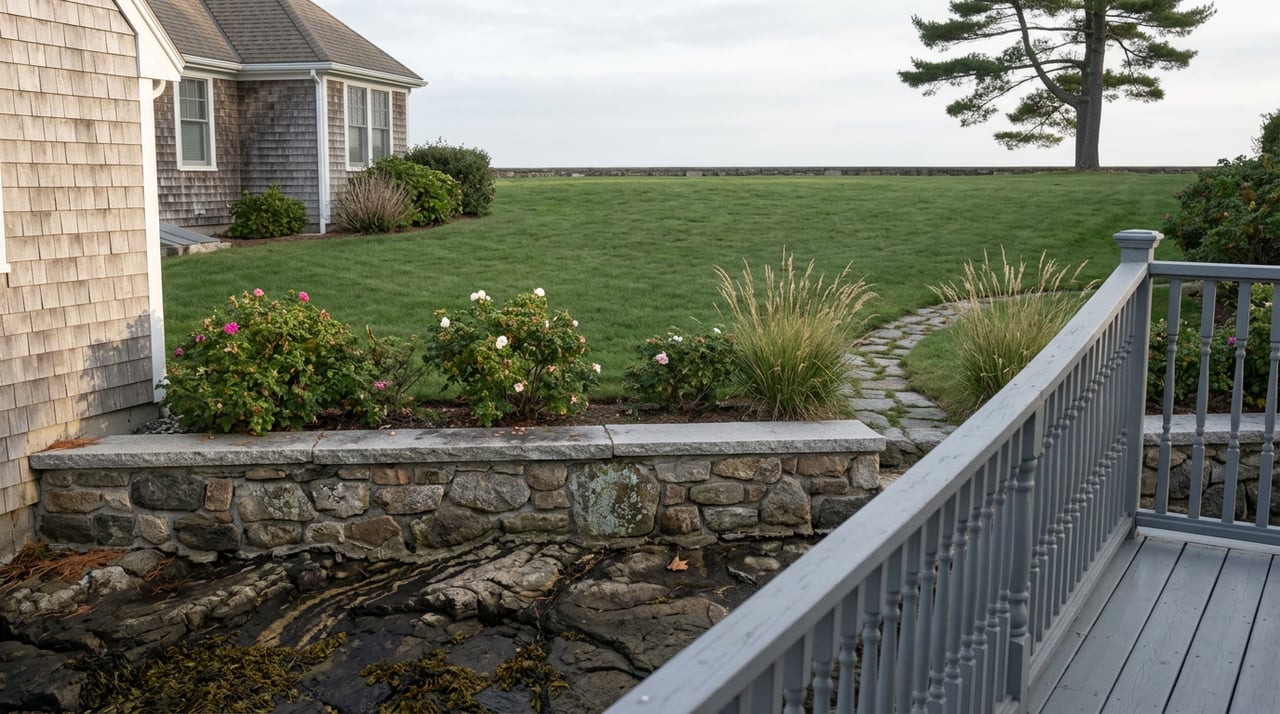
Most buyers assume a waterfront lot ends where the water begins. In Maine, it doesn't. Since the 1641-47 Colonial Ordinance was adopted into Massachusetts Bay Colony law and later carried into Maine's own common law after statehood in 1820, private ownership of coastal land here extends past the high-tide mark and continues out to the mean low-water line. Maine is one of only a handful of states, alongside Delaware, Massachusetts, New Hampshire, Louisiana, and Virginia, where this is true. Everywhere else along the U.S. coast, the intertidal zone, the strip of shoreline the tide covers and uncovers twice a day, belongs to the public or the state. In Midcoast Maine, it usually belongs to the same person who owns the house above it.
That extra strip of ground isn't unrestricted, though. In 1989, the Maine Supreme Judicial Court's decision in Bell v. Town of Wells confirmed private title down to the low-water mark, but it also confirmed that the public retains a narrow easement across that same ground for fishing, fowling, and navigation, language lifted directly from the 1600s ordinance. In practice, that means:
So a Midcoast waterfront owner ends up holding something unusual: full private title to a strip of shoreline that the public can still legally cross for specific, limited purposes. It's a real estate quirk that rarely comes up until someone tries to enforce a "no trespassing" sign against a clam digger, or until a buyer asks what, exactly, they're paying for when the listing says the lot runs "to mean low water."
That question isn't hypothetical right now. A case working its way through Maine's highest court could reshape how much of that intertidal ground stays private.
In April 2021, more than twenty plaintiffs filed Peter Masucci et al. v. Judy's Moody, LLC, a suit centered on Moody Beach in the town of Wells that directly challenges the 1989 Bell decision and asks the courts to expand public rights across privately owned intertidal land statewide. The case moved through a series of Superior Court orders between 2022 and 2024. Justice John O'Neil dismissed most of the plaintiffs' claims, reaffirming that upland owners hold title to the low-water mark, and separately denied requests from both the Attorney General and advocacy groups seeking a broader public right to walk the intertidal zone unrestricted. One narrower claim, over whether the public's protected uses might reasonably extend to activities like walking, running, or scientific research, survived dismissal and is now on appeal to Maine's Law Court, docketed as Cum-24-82. Oral arguments were heard in October 2024, and as of this writing, no ruling has been issued.
Whatever the Law Court decides won't just settle a dispute over one beach in York County. Every party involved has acknowledged the outcome will apply to intertidal land up and down the entire Maine coast, including the shorefront in Damariscotta, Camden, and Brunswick that Adrianne represents every season. A ruling that widens the public's permitted uses would touch the value and marketability of private shorefront statewide. A ruling that narrows the current standard would do the opposite. Either way, it's not background noise for someone weighing a waterfront purchase this year. It's a live variable in what that title actually guarantees.
For sellers, this argues for being direct with buyers about what the deed conveys and what it doesn't, rather than letting a listing photo of an empty beach imply more exclusivity than the law provides. For buyers, it argues for asking a title company or closing attorney a specific question before signing: does this property's chain of title include any recorded language addressing intertidal rights, and has anything in the pending appeal changed how title insurers are underwriting waterfront parcels along this stretch of coast.
If the intertidal question is the one buyers don't know to ask, the septic requirement is the one that catches people off guard closer to the closing date itself.
Under 30 M.R.S. §4216, any property transfer involving a subsurface wastewater disposal system located within a shoreland zone triggers two obligations. First, the seller has to provide a written statement disclosing whether the system has malfunctioned in the 180 days before the transfer. That disclosure lives in Paragraph 21 of Maine's standard Purchase and Sale Agreement, which is worth reading closely rather than skimming past. Second, the buyer is required to have the septic system inspected by a state-certified inspector before purchase, or within nine months afterward if weather makes a pre-purchase inspection impossible. If that inspection turns up a malfunction, state law requires it be repaired or replaced within a year of the transfer.
None of this used to apply as broadly as it does now. When the law was originally enacted in 2007, it only covered coastal shoreland zones. In 2019, the legislature expanded it to cover every shoreland zone statewide, effective January 1, 2020, which means the requirement now reaches far beyond saltwater frontage.
| Before January 2020 | Since January 2020 | |
|---|---|---|
| Where the rule applied | Coastal shoreland zones only | All shoreland zones statewide |
| Water bodies covered | Tidal coastline | Tidal coastline, great ponds, rivers, certain streams |
| Who this catches | Oceanfront buyers | Oceanfront, riverfront, and pond-front buyers alike |
That last row matters more than it looks. A house on the Damariscotta River, a camp on a good-sized pond outside Brunswick, or an in-town lot backing onto a coastal marsh can all fall within 250 feet of qualifying water, the standard shoreland buffer distance, and trigger the inspection requirement even when there's no beach in sight and the listing never mentions "waterfront" at all.
A few exceptions soften the rule. A septic system installed within the past three years is exempt from a new inspection. If the seller already has a certified inspection report from within the past three years, the buyer can rely on that instead of ordering a new one. And if the buyer certifies to the local plumbing inspector that they intend to replace the system within a year of closing, the inspection requirement is waived. Outside those exceptions, though, the obligation stands, unenforced by the state, and enforced in practice by everyone else at the closing table who won't move forward without the paperwork.
Two rules, one about ownership and one about plumbing, share the same lesson: in Midcoast Maine, the state writes the requirement and leaves the follow-through to the people actually closing the deal. That puts more weight than usual on due diligence done early, not discovered late.
For buyers, that means asking two questions before writing an offer rather than after: is this parcel, coastal or not, inside a 250-foot shoreland buffer, and if so, has the septic system been inspected within the past three years. It also means asking whether the intertidal strip in front of the house is included in the deeded lot, and if title work reflects any language shaped by the ongoing Masucci litigation.
For sellers, it means gathering septic records before listing, since a current inspection report can save weeks during a fall or winter closing when frozen ground makes new inspections difficult to schedule. It also means being straightforward about what the tideline conveys and what it doesn't, especially for parcels where the beach itself is part of the appeal.
Does the low-water-mark ownership rule apply to lakefront and riverfront property too, or just the ocean? The ownership extension to the low-tide line is specific to tidal, coastal land under the Colonial Ordinance. Freshwater shoreland properties, ponds and rivers, follow Maine's separate shoreland zoning setback framework, which governs how close structures and septic systems can sit to the water, but doesn't extend private title the same way tidal land does.
If my septic inspection turns up a problem right before closing, does that delay the sale? Not necessarily. The statute requires repair or replacement within a year of the transfer, not before it. The closing itself can proceed while that work is scheduled, though buyers and sellers often negotiate who covers the cost as part of the purchase agreement.
Is the septic inspection rule really coastal-only? It was, until 2020. Since the 2019 amendment took effect, the requirement covers every shoreland zone in the state, tidal or fresh water, which means a pond-front camp well inland can trigger the same inspection rule as a saltwater cottage on the coast.
Waterfront transactions in Midcoast Maine carry more moving legal pieces than the listing photos ever suggest. Twenty years spent reading contracts before ever writing one taught Adrianne Zahner that the details buyers skip are usually the ones that matter most at closing. If you're weighing a waterfront purchase or preparing to list one along the Damariscotta River, in Camden and Rockport, or anywhere else along this stretch of coast, Let's Connect before you're staring down a closing date with an open question about the septic system or the deed line. It's a conversation worth having early.
Stay up to date on the latest real estate trends.







Whether you’re buying your first home, upgrading to something new, or selling a beloved property, I’m here to provide expert guidance, clear communication, and thoughtful advocacy. I’m ready to help you take the next step.

Adrianne Zahner
Legacy Properties Sotheby’s International Realty 40 Main St Damariscotta ME 04543